

Warehouse Dock Lights: Safer Visibility at Loading Doors
A lorry can be correctly positioned outside a warehouse, yet the doorway may still appear almost black from the driver’s seat. That sudden change between a bright yard and a dark loading bay makes door edges, pedestrians, shutter guides, and dock equipment harder to see.
Well-planned warehouse dock lights give drivers a clear view of the opening and help loading teams work safely during early starts, late finishes, and poor weather. The best results come from combining suitable fixtures with sensible positioning, reliable doors, and routine maintenance.
How warehouse dock lights improve visibility at loading doors
Loading bays often have several sources of uneven light. External floodlights may brighten the yard but leave the underside of a canopy in shadow. Interior fittings may light the warehouse floor while leaving the threshold and trailer entrance poorly defined.
Drivers reversing towards a doorway need to judge distance, alignment, and clearance at the same time. A bright fitting aimed directly at the cab can create glare, while a weak fitting behind the door can turn the opening into a dark rectangle. Both conditions make visual judgement more difficult.
Effective doorway lighting should reveal:
- The full width of the door opening.
- Vertical guides, frames, dock levellers, and wheel guides.
- People walking near the bay.
- The trailer’s rear edges and interior floor.
- Obstacles, spillages, and changes in level around the threshold.
The light needs to cover the working area without shining into a driver’s windscreen. It should also work alongside yard lighting, internal warehouse fittings, vehicle lights, and any reversing alarms or cameras already in use.
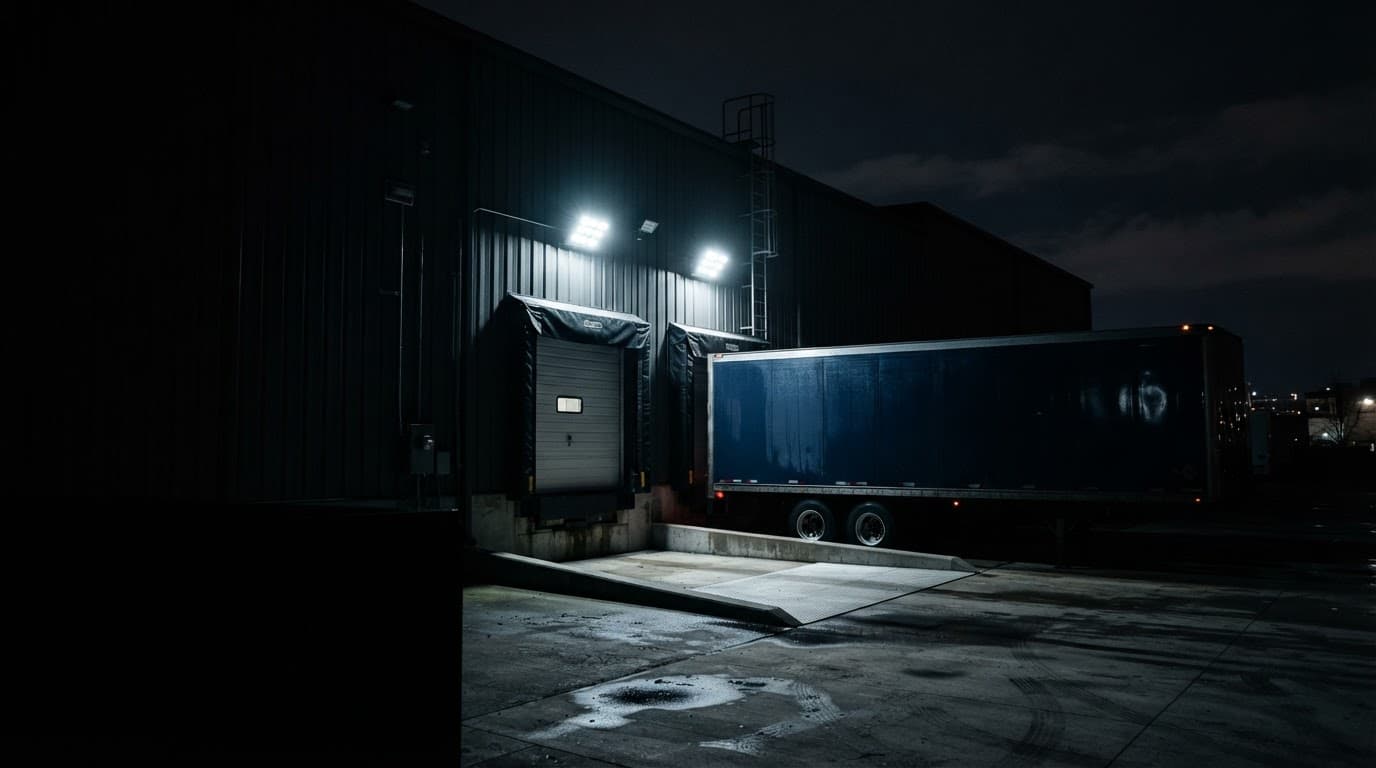
Bright lights illuminate a dark warehouse loading bay at night.
The principle is simple: drivers should see the doorway as a defined working area, rather than a dark gap in the building.
OSHA’s lighting standard states that work areas and walkways should have adequate lighting whenever employees are present. That standard applies to US shipyard employment, so UK sites must still follow their own risk assessments and applicable requirements. However, the underlying point applies to every busy loading area.
Lighting should help a driver see the door, the ground, and nearby people without creating glare that hides the same hazards.
Match the light to the dock layout
There isn’t one fitting that suits every warehouse entrance. The right choice depends on whether the dock is internal or external, how often vehicles arrive, the amount of natural light, and the door’s design.
External LED fixtures work well around open loading yards. A wall-mounted light above or beside each bay can illuminate the approach and the doorway edge. Weather-resistant housings are important where fittings face rain, wind, dust, or vehicle spray.
An articulated dock light is fixed inside the loading bay and uses an adjustable arm. Staff can move the lamp towards the trailer when loading begins, then position it safely out of the way afterwards. This type of fitting is useful when the trailer interior needs extra light, although it should not replace lighting outside the threshold.
Canopy-mounted or recessed fittings suit sites with limited wall space. They reduce clutter around the opening, but access for inspection and replacement needs to be considered before installation. A fitting that requires specialist access equipment every time it fails can increase downtime.
The main options can be compared quickly:
| Lighting option | Suitable use | Main point to check |
|---|---|---|
| External LED doorway light | Outdoor approaches and individual bays | Avoid glare into vehicle windscreens |
| Articulated internal dock light | Trailer interiors and loading work | Protect the arm from impacts |
| Canopy or recessed light | Low-clearance or tidy dock areas | Allow safe access for maintenance |
| Combined external and internal lighting | Busy sites operating day and night | Balance coverage between both zones |
In many warehouses, a combined arrangement works best. Exterior light helps drivers align with the opening, while a focused internal fitting helps staff see into the trailer.
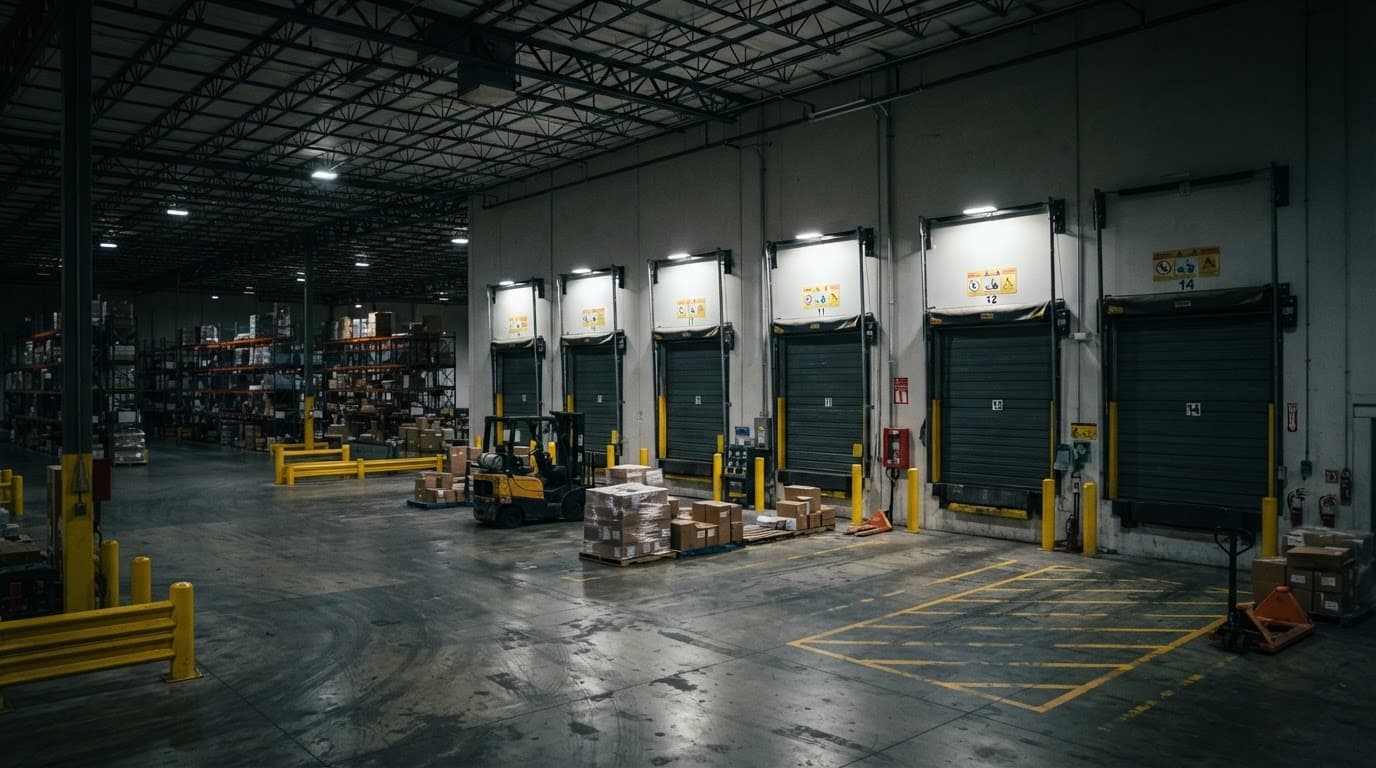
Warehouse loading dock with heavy doors and bright safety lights.
Place fixtures to control glare and shadows
Position matters as much as output. A powerful lamp in the wrong place can make a doorway harder to use.
Fit external lights high enough to protect them from vehicle strikes, but angle them towards the ground and the door face. The beam should spread across the threshold instead of pointing straight along the driver’s line of sight. Lighting both sides of a wide opening helps prevent one side of the trailer from disappearing into shadow.
Door frames and overhead canopies often create dark strips. Check the area below the lintel, around the shutter guides, and beside the dock leveller. These points should remain visible when a vehicle is close to the building.
Testing should take place in daylight and darkness. A fitting that looks suitable at midnight may create excessive contrast at dawn. Check different trailer heights and vehicle positions too, because a light that works for one trailer may shine into the mirrors of another.
Neutral white LED lighting often gives a clear view of edges, surfaces, and warning colours. The exact specification should follow the work being carried out, the fitting location, and the manufacturer’s guidance. A published loading dock lighting requirements article refers to 20 lux for general visibility under one OSHA reference. That number shouldn’t be treated as a universal UK target. A competent person should assess the actual task and measure the finished installation.
Photocells can switch external lights on when daylight fades. Timers may suit predictable shift patterns, but controls mustn’t leave a working bay dark while people or vehicles are still present. Manual override controls are useful during deliveries, maintenance, and unexpected late-night work.
Connect doorway lighting with doors and traffic controls
Lighting can’t correct every loading bay risk. Drivers still need clear reversing procedures, suitable pedestrian routes, visible markings, and enough room to manoeuvre. Where a banksperson, camera, mirror, or traffic light is part of the site’s system, the lighting should support it rather than create reflections or blind spots.
The door itself also affects visibility. Roller shutters with side guides, bottom rails, and projecting hardware need light across the full frame. When a shutter is closed, drivers and pedestrians should be able to see its lower edge clearly. Keep fixtures away from moving curtains and avoid fitting cables where they could catch on the door.
High-speed doors can help busy warehouses control access and reduce the time an opening remains exposed to outdoor conditions. They suit internal routes, loading areas, and sites with repeated forklift movements. UK Doors & Shutters provides information about high speed warehouse doors and how they can work alongside tougher outer shutters or doors.
Powered shutters also suit loading areas where pallets move in and out throughout the day. Electric operation reduces repeated manual effort and can support quicker access. Manual shutters remain practical for lower-use openings where powered operation isn’t needed. Either type needs enough light around the threshold for safe operation and inspection.
Where temperature control matters, insulated double-skinned roller shutters can reduce draughts around the opening. Lighting won’t prevent heat loss, but a properly selected door can help the building maintain more stable internal conditions while the lighting improves visibility during each movement.
Keep lights and loading doors ready for daily use
A failed lamp is easy to overlook until a night delivery arrives. Small faults can also develop around the fitting, including loose brackets, water ingress, damaged lenses, flickering LEDs, and exposed cables.
Add doorway lighting to routine site inspections. Staff should report lights that:
- Flicker or take time to start.
- Leave one side of the opening in shadow.
- Shine into vehicle windscreens.
- Move after wind, impact, or building work.
- Switch off while the bay is still in use.
Clean lenses when dust, grease, or exhaust residue reduces the output. Loading bays collect more dirt than many other areas because vehicles bring moisture and debris close to the building. A dirty cover can reduce useful light even when the LED itself still works.
The door and lighting should also be checked after a vehicle strike. A damaged shutter guide, bent dock arm, or displaced lamp can affect both security and visibility. Staff shouldn’t force a door that is sticking or make temporary electrical repairs without authorisation.
Regular shutter servicing helps engineers identify wear before a failure causes a complete closure. UK Doors & Shutters recommends servicing roller shutters twice each calendar year, with the precise interval adjusted to usage and site conditions. Include light fittings, mounting points, controls, and cables in the same planned inspection where practical.
Keep records of faults, repairs, replacement parts, and service dates. These records help facilities teams spot repeated problems and give engineers useful information when several bays have similar equipment.
Plan a safer dock lighting upgrade
A site survey should look beyond the lamp’s brightness. The installer needs to assess the door dimensions, canopy, trailer position, mounting height, existing electrical supply, vehicle routes, and exposure to weather or impact.
Ask for the following points to be covered:
- The areas drivers and pedestrians need to see.
- Possible glare from the cab approach or nearby windows.
- The protection required for fittings near moving vehicles.
- How the lights will operate during normal and emergency work.
- Access for cleaning, testing, and future replacement.
- Compatibility with shutters, high-speed doors, dock equipment, and controls.
The survey should also identify whether a single fixture leaves dark corners. Several correctly positioned lower-output lights can provide better coverage than one very bright lamp. A lighting meter can confirm the result rather than relying on appearance alone.
When a new shutter or door is being installed, plan the lighting at the same time. The position of the headbox, guides, motor, safety edges, and controls can affect where an electrician can mount a fitting. Coordination prevents later drilling, exposed cabling, and awkward maintenance access.
UK Doors & Shutters supplies, installs, repairs, and services commercial and industrial doors across Bolton, the North West, and the wider UK. With more than 30 years of experience, free surveys, and 24/7 emergency support, the team can review the doorway as part of a wider access and security plan. To discuss a loading bay, shutter, or door project, Contact Us.
Conclusion
A dark loading doorway makes every approach harder to judge. Correctly positioned warehouse dock lights show the frame, threshold, trailer, and people without directing glare into the driver’s view.
The strongest setup combines exterior and interior coverage with suitable shutters or high-speed doors, clear traffic controls, and regular inspections. Review the complete doorway rather than choosing a fitting by brightness alone, and visibility will remain reliable through every shift.
Discover more from UK Doors and Shutters
Subscribe to get the latest posts sent to your email.


Leave a Reply
Want to join the discussion?Feel free to contribute!